
Choosing the 2026 best Screw Driven Air Compressor requires more than comparing horsepower, price, or brand reputation. Real performance appears on the factory floor, beside hot machinery, oil mist, dust, and changing production loads. A strong model must deliver stable pressure, efficient airflow, dependable cooling, and practical maintenance access. It should also support modern monitoring, variable-speed control, and responsible energy management.
Compressed-air specialist Ron Marshall has often warned, “Compressed air is one of the most expensive forms of energy.” That observation deserves attention. A compressor running eight hours daily can quietly consume more electricity than expected, especially when leaks, oversized motors, or poor control settings remain unnoticed. The best Screw Driven Air Compressor for 2026 should therefore be judged by lifecycle cost, not only its purchase price. Energy use matters. Service access matters more than many buyers admit.
This guide examines oil-injected and oil-free designs, fixed-speed and variable-speed systems, airflow ratings, noise levels, filtration, and controller functions. It also considers real workshop conditions. A brochure may promise impressive efficiency. Reality can be less tidy. Ambient heat may reduce output. A neglected separator can raise operating costs. Even a premium compressor can disappoint when installation is poorly planned.
Our comparison aims to remain practical, evidence-based, and honest about trade-offs. No single machine suits every plant. The right choice depends on duty cycle, air quality requirements, available space, and future production demands. Performance should be measured, not assumed.
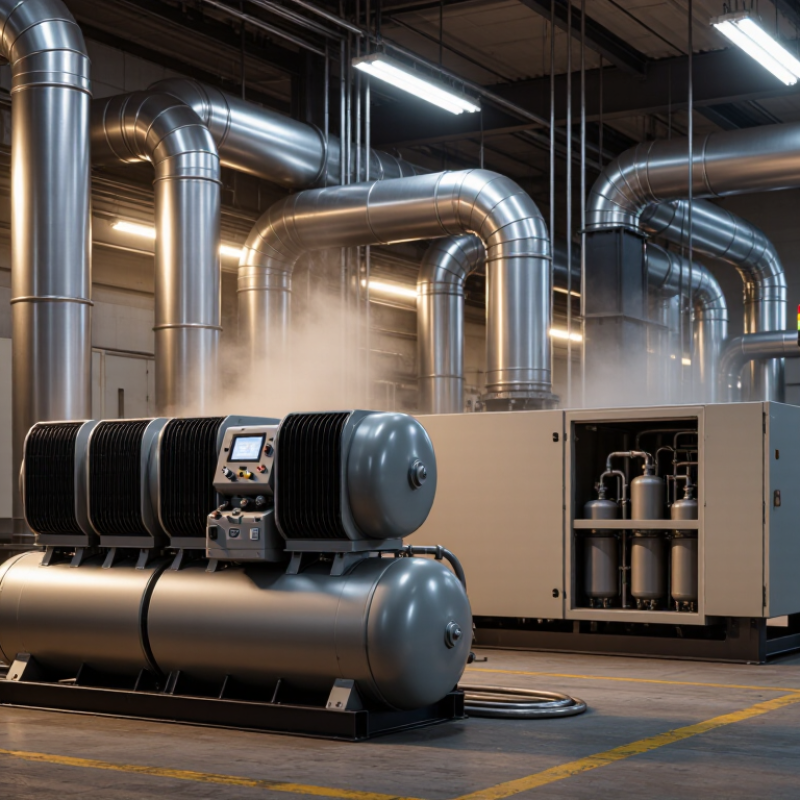
What Is the 2026 Best Screw Driven Air Compressor?
Definition and Working Principles of Screw-Driven Air Compressors
A screw-driven air compressor uses two helical rotors to compress air continuously. The rotors turn inside a precisely machined chamber. Air enters through the inlet valve and fills the spaces between the rotor grooves. As the rotors rotate, these spaces become smaller. Pressure rises before compressed air reaches the outlet.
Many industrial models inject oil during compression. The oil reduces friction, seals tiny gaps, and carries away heat. A separator then removes oil from the compressed air. Cooling stages lower the discharge temperature before air enters the plant system. Oil-free designs use different sealing and cooling methods. They suit applications requiring very clean air, such as medical or food-processing equipment.
In field inspections, airflow stability often matters more than peak pressure. A properly selected unit should match the plant’s duty cycle, air demand, and working pressure. Variable-speed control can reduce wasted energy when demand changes. However, it may not solve poor pipe design or neglected filters. I have seen pressure drop caused by a clogged intake filter, not a compressor fault. That detail is easy to miss. Regularly checking oil level, separator condition, temperature, and vibration supports safer operation. The “best” compressor in 2026 is therefore not universal. It is the one whose screw design, cooling system, controls, and maintenance access fit the real workplace.
| Evaluation Dimension | Technical Data or Principle | Why It Matters | Recommended 2026 Selection Guidance |
|---|---|---|---|
| Compressor Definition | A screw-driven air compressor is a positive-displacement compressor that uses two intermeshing helical rotors to trap and compress air. | It provides a continuous air supply instead of the intermittent delivery commonly associated with reciprocating compressors. | Choose a rotary screw design for applications requiring steady airflow and long operating periods. |
| Compression Process | Air enters through the inlet valve, is trapped between the rotor lobes and housing, and is compressed as the volume of the air pocket decreases. | The process produces a stable flow with relatively low pulsation. | Select a compressor whose rated flow and pressure match the actual plant demand rather than relying only on motor horsepower. |
| Rotor Configuration | Most industrial units use a male rotor and a female rotor with precisely timed helical profiles. | Rotor geometry affects capacity, efficiency, noise, and service life. | Prioritize proven rotor profiles, durable bearings, and documented efficiency data. |
| Lubricated or Oil-Injected Type | Oil is injected into the compression chamber to seal internal clearances, lubricate moving parts, and remove heat. | Oil injection allows efficient compression but requires oil separation, filtration, and scheduled maintenance. | Best suited to general manufacturing, workshops, assembly lines, and applications where technically treated compressed air is acceptable. |
| Oil-Free Type | Oil-free screw compressors use non-lubricated compression chambers and typically rely on special coatings, precision clearances, and staged cooling. | They reduce the risk of oil contamination in the compressed-air stream. | Consider this type for pharmaceutical, food-processing, electronics, medical, and other oil-sensitive applications; verify the required air-quality classification. |
| Typical Pressure Range | Industrial rotary screw compressors commonly operate around 7 to 13 bar(g), with specialized models available outside this range. | Pressure selection affects power consumption and usable airflow. | Choose the lowest pressure that safely meets the highest point-of-use requirement, including an appropriate distribution margin. |
| Typical Capacity Range | Small and industrial screw compressors can cover approximately 0.5 to more than 100 m³/min, depending on design and operating pressure. | Air demand determines the required compressor size and the number of units needed. | Use measured demand data, leakage surveys, and expansion plans to size the system; avoid excessive oversizing. |
| Fixed-Speed Drive | A fixed-speed motor generally runs at a constant speed while capacity is regulated by inlet control, unloading, or modulation. | It can be efficient near a stable full-load duty point but may consume more energy during low-demand periods. | Choose fixed speed when demand is relatively constant and the compressor operates near its design load for most of the shift. |
| Variable-Speed Drive | A variable-speed drive adjusts motor speed to follow changing compressed-air demand. | It can reduce unloaded running and improve part-load efficiency, although drive losses and operating conditions must be considered. | Often the better choice for systems with significant daily or seasonal demand variation. |
| Energy Efficiency | Efficiency should be evaluated using specific power, usually expressed as kW per m³/min or kW per 100 cfm at a stated pressure. | Motor rating alone does not show the total energy required to produce compressed air. | Compare specific-power figures at the same pressure, flow, inlet condition, and measurement standard. |
| Motor and Drive System | Common systems use electric induction motors, while high-efficiency motor and drive combinations may reduce operating losses. | The motor and drive account for a substantial part of the compressor’s lifetime energy use. | Review motor efficiency, drive efficiency, service factor, harmonics, and compatibility with the site electrical supply. |
| Cooling Method | Air-cooled units reject heat through a fan and cooler; water-cooled units use a cooling-water circuit and heat exchangers. | Cooling conditions influence reliability, installation requirements, and operating temperature. | Use air cooling where installation simplicity is important; consider water cooling where ambient conditions or heat-recovery requirements justify it. |
| Noise and Vibration | Screw compressors generally produce smoother airflow and lower pulsation than reciprocating compressors, although fan, motor, and enclosure noise remain relevant. | Noise affects worker comfort and installation location. | Check the declared sound-pressure level, enclosure design, vibration isolation, and required clearance before installation. |
| Air Treatment Requirements | Compressed air may require an aftercooler, moisture separator, refrigerated or desiccant dryer, coalescing filters, and particulate filters. | Compression alone does not remove all water, oil aerosols, or particles from the air stream. | Specify air treatment according to the end use and the applicable compressed-air quality requirements. |
| Maintenance Items | Typical service items include oil, oil filters, air filters, separators, coolers, belts or couplings, bearings, valves, and condensate drains. | Maintenance condition directly affects efficiency, pressure stability, and service life. | Prefer accessible service points, clear maintenance intervals, condition monitoring, and readily available replacement parts. |
| Control and Monitoring | Modern controllers can monitor pressure, temperature, running hours, load status, alarms, and maintenance intervals. | Better data supports preventive maintenance and helps identify leaks or abnormal energy use. | Prioritize controllers with trend logging, remote communication, fault history, and multi-compressor sequencing when required. |
| Duty Cycle | Rotary screw compressors are designed for continuous or near-continuous industrial operation when correctly sized and cooled. | Continuous-duty capability makes them suitable for production processes with sustained airflow demand. | Confirm the permitted operating hours, ambient-temperature limits, altitude limits, and required service intervals. |
| Installation Conditions | The installation area should provide clean intake air, adequate ventilation, drainage, service access, and protection from excessive dust or heat. | Poor installation conditions can reduce capacity and shorten component life. | Check ventilation airflow, room temperature, floor loading, electrical capacity, pipe sizing, and condensate management before purchase. |
| Best Overall Use Case | A variable-speed, properly sized screw compressor with suitable air treatment and monitoring is generally a strong solution for variable industrial demand. | System efficiency depends on the complete compressed-air installation, not only the compressor package. | For 2026, select the unit with the best verified lifecycle efficiency, air quality, reliability, service support, and total cost of ownership for the specific application. |
It uses two helical rotors to compress air continuously. Air fills the rotor grooves, then pressure rises as the spaces shrink. The process is smooth.
Oil-injected models use oil to reduce friction, seal gaps, and remove heat. A separator removes most oil afterward. Oil-free designs use alternative sealing and cooling methods for cleaner air.
There is no universal winner. The right model matches air demand, pressure, duty cycle, cooling, controls, and maintenance access. Real workplace conditions matter more than headline horsepower.
Around 15–20 percent headroom is practical, but measured demand should guide the decision. Compare free air delivery at the required pressure. A 10-bar rating may struggle under continuous demand at 8 bar.
No. It can reduce unloaded running when demand changes. A steady, high-demand line may suit fixed-speed operation better. Control limits and test conditions need checking.
Place it in a clean, dry, and ventilated room. Keep space around filters, coolers, and electrical panels. Avoid dust, heat, and chemical vapors. A level foundation helps prevent vibration.
Check filters, oil, separators, coolers, vibration, temperature, and drains regularly. Test leaks with ultrasonic equipment. Record trends. A checklist can still miss a hot bearing.
Blocked intake filters, undersized pipes, leaks, or excessive demand may cause pressure loss. Do not raise discharge pressure automatically. A 2-psi increase can raise energy use by roughly 1%. That adds up.
A Screw Driven Air Compressor uses rotating helical screws to continuously compress air, providing a stable and efficient supply for industrial, commercial, and workshop applications. Unlike intermittent compression systems, its smooth operating cycle can reduce vibration, noise, and pressure fluctuations. When selecting a 2026 model, users should consider air delivery, working pressure, motor power, energy consumption, duty cycle, control systems, cooling method, and overall lifecycle cost. Different designs, including oil-injected and oil-free configurations, serve different requirements for air quality, operating conditions, and maintenance expectations.
Proper installation requires suitable ventilation, electrical capacity, drainage, and clean intake air. Regular inspection of filters, lubricants, belts, connections, and control components helps maintain reliable performance and extend service life. Operators should follow manufacturer instructions, workplace safety procedures, and applicable standards. Future developments are expected to focus on variable-speed technology, intelligent monitoring, heat recovery, lower emissions, and improved energy efficiency, helping businesses achieve dependable compressed-air performance with reduced operating costs.
