
China’s electric screw air compressor market includes manufacturers serving factories, workshops, and large production lines. This guide introduces ten Chinese manufacturers and considers their product ranges, engineering capabilities, and service support. The aim is practical comparison, not an unsupported ranking.
An Electric Screw Air Compressor can run for long shifts, so small design differences matter. Think of a clean equipment room, steady pressure at the production line, and a service technician checking filters before a shift begins. Buyers should compare airflow, operating pressure, motor efficiency, noise levels, controls, and maintenance access. Ask how performance is tested and what support is available after installation. Product specifications are useful, but they do not tell the whole story.
Compressed-air specialist Ron Marshall’s technical guidance can be paraphrased this way: “Measure the system, not just the machine.” That distinction matters. A compressor’s real value depends on how well it serves the facility’s demand over time, not simply its nameplate figures. Still, no single specification guarantees a good fit. Site conditions vary. This overview is a starting point, and manufacturer claims deserve careful verification against technical documents and customer requirements.
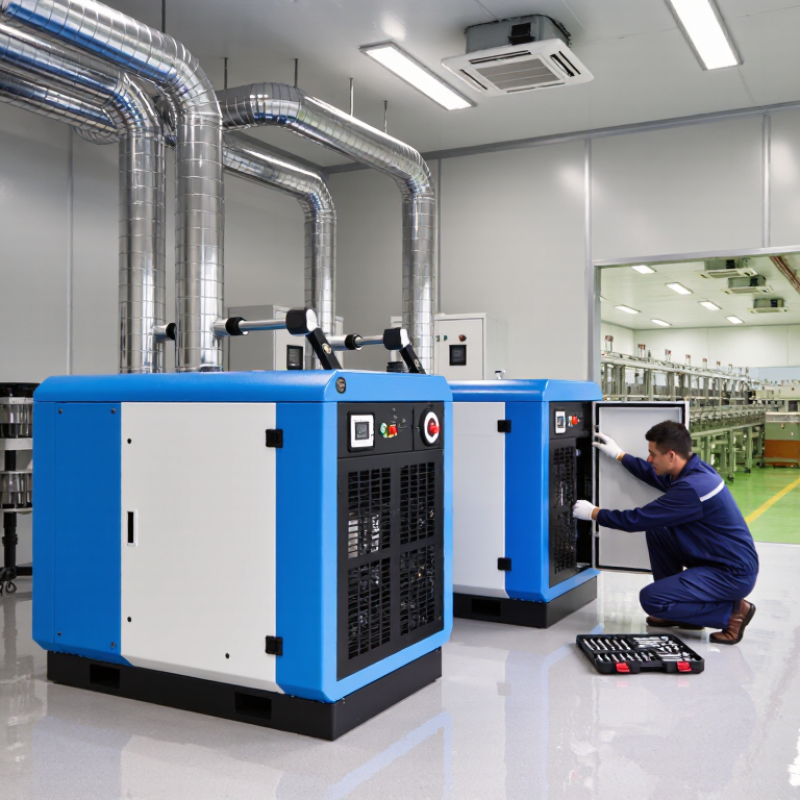
An electric screw air compressor uses an electric motor to turn two intermeshing helical rotors. Air enters through an inlet. Rotating lobes trap it between the rotors and casing. As the trapped space shrinks, air pressure rises and the compressed air moves toward the outlet. The cycle repeats. After compression, an aftercooler and moisture separator can remove heat and condensed water before the air enters storage or treatment equipment.
Many industrial units inject oil to seal clearances, lubricate moving parts, and carry away heat. A separator reduces oil in the outgoing air. Oil-free designs use different rotor and cooling arrangements. Some compressors run at fixed speed; others vary motor speed as demand changes. These options affect energy use, but leaks, unnecessary pressure, and poor controls can still waste power. Operators should check pressure where the air is used, not only on the compressor display.
The U.S. Department of Energy’s 2016 sourcebook, Improving Compressed Air System Performance, estimates that compressed air uses about 10% of U.S. manufacturing electricity. That is a meaningful load. The rotor principle is simple, but real efficiency depends on cooling, leakage, pressure settings, and demand patterns. A quiet machine can still be working harder than necessary.
China’s electric screw compressor industry is shaped by a broad manufacturing base, established component supply chains, and demand from factories seeking steady compressed air. Production ranges from compact units for workshops to larger systems serving textiles, food processing, metalworking, and general manufacturing. The details matter. A clean factory floor does not tell buyers how a compressor performs under continuous load.
Electric screw compressors use paired rotors to compress air, while electric motors provide consistent drive. In real installations, performance depends on more than rated power. Intake temperature, ventilation, pipe layout, operating hours, and maintenance access all affect energy use and reliability. A machine can look efficient on paper and still disappoint in a poorly planned room.
China’s supplier landscape includes manufacturers with different strengths in engineering, customization, and export support. Buyers should compare operating data, service arrangements, spare-part availability, and test documentation rather than rely on headline specifications alone. Ask how performance is measured, and under what conditions. That question is easily overlooked. Some product information may be incomplete, so independent verification is sensible. A site visit or a clear technical discussion can reveal practical details, such as filter access, noise control, and whether the control system suits the plant’s actual air demand.
| Dimension | Industry Snapshot | Context |
|---|---|---|
| Compressor technology | Rotary screw, oil-injected and oil-free | Oil-injected machines are widely used for general industrial compressed air. Oil-free designs are selected where the process requires air produced without oil in the compression chamber. |
| Drive options | Fixed-speed and variable-speed drive | A variable-speed drive adjusts motor speed to respond to changing air demand. Its suitability depends on the load profile, control settings, and system design. |
| Common packaged power band | Approximately 7.5–400 kW | This is a representative range commonly found across industrial packaged screw-compressor catalogs, not a census of Chinese production or a limit on available machine sizes. |
| Common working-pressure options | Approximately 7–13 bar(g) | Many general-purpose industrial models are offered in this range. The required pressure should be determined from the end-use equipment and pressure losses across the distribution system. |
| Cooling methods | Air-cooled and water-cooled | Air-cooled units reject heat to the surrounding room air. Water-cooled units use a cooling-water circuit and require suitable water supply, treatment, and heat-rejection arrangements. |
| Power supply | Three-phase electric power | Industrial screw compressors use three-phase motors. Voltage and frequency must be checked against the installation site and the machine’s nameplate. |
| Air treatment needs | Dryers, filters, and condensate management | Compressed-air treatment is selected according to the required pressure dew point, particle level, and oil content. ISO 8573-1 provides a classification framework for air purity. |
| Typical applications | Manufacturing and process air systems | Common uses include pneumatic tools, production equipment, packaging, and general plant services. Application requirements vary by industry and process. |
| System-efficiency factors | Demand profile, pressure, controls, and maintenance | Energy use depends on more than the compressor’s rated power. Correct sizing, leak reduction, suitable pressure settings, and coordinated controls can improve system performance. |
| Selection checks | Airflow, pressure, air quality, site conditions | Compare machines using the required delivered airflow and operating conditions, then verify noise limits, ambient temperature, cooling arrangements, service access, and applicable compliance requirements. |
| Note: Figures shown are indicative product-category ranges rather than verified market totals. Confirm exact performance, configuration, and compliance details in the relevant product documentation. | ||
When comparing Chinese electric screw air compressor manufacturers, examine test evidence, not brochure claims. Ask for measured flow, input power, discharge pressure, and sound level at stated operating conditions. ISO 1217 provides a basis for displacement-compressor performance testing. Comparable test conditions make quoted efficiency more meaningful.
Energy figures deserve close scrutiny. The U.S. Department of Energy’s Improving Compressed Air System Performance sourcebook reports that leaks can waste 20–30% of compressor output in poorly maintained systems; well-maintained systems typically keep leakage below 10%. This makes service access, leak-detection support, and clear maintenance schedules practical selection criteria. Ask whether a supplier can provide operating data from a test bench, plus local references with similar duty cycles. Numbers need context.
Compare lifecycle cost, not just purchase price. Request a written breakdown covering motor efficiency, control strategy, filters, oil, and expected service intervals. Check whether spare parts are stocked domestically and whether technicians can respond quickly. A detailed warranty is useful, but its exclusions matter just as much. Factory visits can reveal assembly discipline, calibration records, and how finished units are checked. A polished showroom proves little. Some suppliers may publish incomplete field data, and buyers should acknowledge that limitation rather than treat estimates as certainty.
China’s Top 10 Electric Screw Air Compressor Manufacturers should be compared by engineering capability, not advertising claims alone. A strong supplier can explain how its rotor profile, motor efficiency, and cooling design affect performance under real operating conditions. Ask for measured airflow and power consumption at the pressure your facility needs. Numbers without test conditions are hard to compare.
Look closely at the details. Check whether the unit supports continuous operation, and ask how its controller responds when demand changes during a shift. Review service access, filter replacement intervals, noise data, and the availability of technical documentation. Small practical details matter. A compact machine may fit neatly beside a production line, but cramped access can make routine maintenance slower. Request test records and warranty terms in writing, then confirm that they match the proposed configuration.
A top-ten list is only a starting point, not proof that one manufacturer suits every site. Compare several suppliers against the same duty cycle and operating pressure. Where possible, speak with users in similar industries and inspect a running installation. There is no perfect specification sheet. Real performance can vary with ambient heat, piping, and maintenance habits, so leave room for careful verification.
Electric screw air compressors are usually offered in oil-injected and oil-free designs, with fixed-speed or variable-speed drives. For a China-focused top-ten comparison, buyers should examine pressure range, airflow, motor power, cooling method, and service access—not just the headline efficiency figure. A compact unit may suit a machine shop, while a larger multi-stage system can support continuous production. Small details matter.
Applications shape manufacturer specialization. Oil-free models are often specified where air quality is critical, including food processing, electronics, and pharmaceutical production. Oil-injected units are common in general manufacturing, workshops, and construction support. The U.S. Department of Energy’s Improving Compressed Air System Performance sourcebook reports that compressed air can account for about 10% of industrial electricity use, and as much as 30% in some facilities. That makes controls, leak management, and correct sizing important purchasing criteria.
Some manufacturers focus on high-pressure packages; others emphasize quiet enclosures, integrated dryers, or variable-speed control. The same DOE sourcebook estimates that leaks can waste 20–30% of a compressor’s output in poorly maintained systems. Ask suppliers for measured flow and power data at the intended operating pressure, plus maintenance intervals and parts availability. Catalog figures are useful, but site conditions can change the result. A plant’s real demand is not always neat.
Ask for measured airflow, input power, discharge pressure, and sound level. The test conditions should be stated. Numbers need context.
Compare units at the same pressure and duty cycle. Request test-bench records, not brochure estimates. Small differences can matter over long shifts.
Poorly maintained systems may lose 20–30% of compressor output through leaks. Ask about leak detection, service access, and maintenance schedules. Annoying, but practical.
Request written estimates for motor efficiency, controls, filters, oil, and service intervals. Check local spare-parts stocks and technician response times.
You may see assembly practices, calibration records, and final inspection checks. A polished showroom proves little. Records matter more.
Ask how its controller handles changing demand during a shift. Confirm continuous-operation capability and review service access around the unit.
Read the coverage and exclusions carefully. Confirm the terms match the proposed configuration. I might still miss a detail.
No. Compare several suppliers using the same pressure and duty cycle. Speak with similar users or inspect a running installation. Real conditions vary.
This article introduces the Electric Screw Air Compressor, explaining how paired rotors compress air continuously and why this design is valued for stable output and efficient operation. It also provides an overview of China’s electric screw compressor industry, including the range of manufacturers and product capabilities available to industrial buyers.
To help readers compare suppliers, the article outlines practical criteria such as performance, energy efficiency, reliability, customization, service, and application fit. It then surveys ten manufacturers without focusing on brand promotion, highlighting how their products may differ in configuration and specialization. Finally, it connects compressor features to common uses across industries, helping readers understand which machine characteristics matter for different operating needs and how to make a more informed equipment selection.
