
How to Choose a Rotary Industrial Compressor System

Time:2026-11-17 Author:Amelia
0%

Choosing a Rotary Industrial Compressor System is not simply a matter of comparing horsepower or purchase prices. The right choice starts with the work the system must do each day. A packaging line with steady demand has different needs from a workshop where several machines start and stop throughout the shift. Record actual airflow and pressure requirements, including peak demand. A gauge reading alone can mislead.

Machinery-reliability expert Heinz P. Bloch’s work supports a useful principle: “Select the compressor as part of the complete system, not as a standalone machine.” This is a paraphrase, not a verbatim quotation. Consider rotary screw and vane designs, then compare fixed-speed and variable-speed options against your demand pattern. Check the required pressure, air quality, cooling, noise limits, available floor space, and maintenance access. A unit that fits neatly beside a wall may be awkward to service. Small detail. Ask about lifecycle costs, too: energy, filters, separators, oil, and planned downtime can outweigh the initial price.

The following guide explains how to assess these factors without treating a specification sheet as the whole story. It also highlights practical questions to ask suppliers, such as how performance changes under partial load and what service intervals mean for your operating schedule. No system is perfect. Demand estimates can be wrong, and future production changes are easy to underestimate. Revisit your assumptions before choosing. A careful selection should fit today’s workload while leaving sensible room for tomorrow.
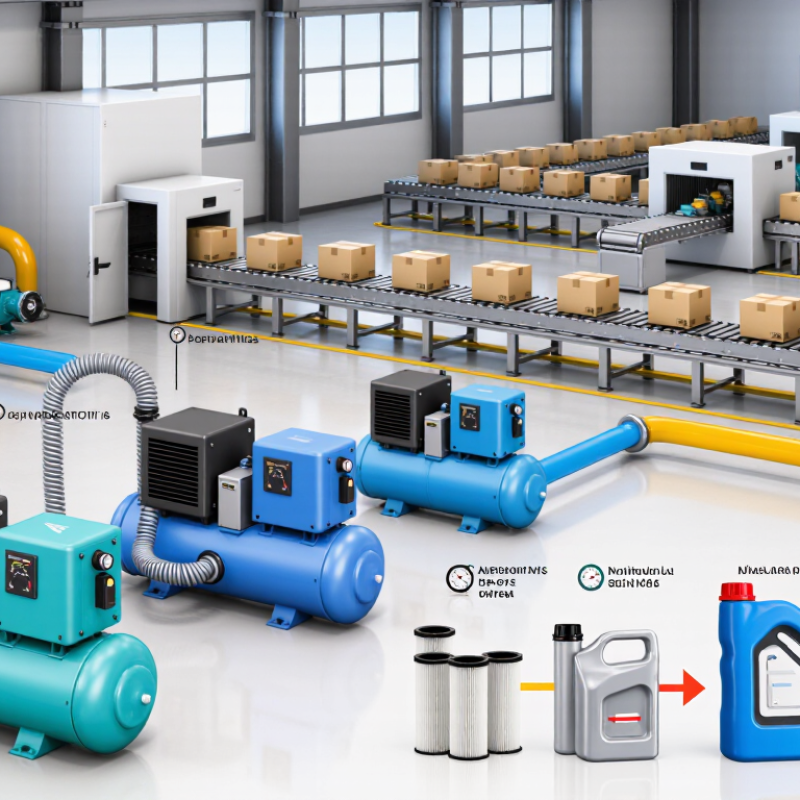
How to Choose a Rotary Industrial Compressor System

Define the Compressed Air Requirements of the Application

A rotary industrial compressor should be sized around measured demand, not the largest tool on the floor. Record flow in cubic feet per minute or litres per second during normal production, peak shifts, and equipment start-up. Measure pressure at the point of use, too. A compressor-room gauge can hide pressure losses through long, narrow pipes, filters, and dryers. Measure it first.

The U.S. Department of Energy’s Improving Compressed Air System Performance: A Sourcebook for Industry reports that compressed air uses about 10% of industrial electricity in the United States, and can reach 30% in some facilities. That makes demand assessment an energy decision, not just a sizing exercise. Note which machines run together, how often loads cycle, and whether air quality requirements call for filtration or drying. These details affect both usable capacity and system pressure.

Compare logged demand with equipment specifications, then allow for realistic production changes rather than an arbitrary safety margin. Check for leaks and pressure drops before choosing a larger rotary compressor; extra capacity may mask problems while increasing energy use. Include future demand, but be honest about uncertainty. A new production line may never arrive. I would revisit the measurements after installation, because estimates on paper can miss a messy shift change or a short, sharp demand spike.

Compare Rotary Compressor Types and Operating Principles

Rotary compressors move air through chambers that change in size or position. Their steady delivery can suit production lines with frequent demand. The operating principle, however, differs by design.

In a screw compressor, two helical rotors trap air and carry it toward a smaller discharge space. The shrinking volume raises pressure. Oil-injected models use oil for sealing and cooling, while oil-free designs keep oil out of the compression chamber. Listen near the outlet: a smooth sound may still hide heat or pressure losses. Check operating conditions, not sound alone.

A rotary-vane unit uses an off-center rotor with sliding vanes. As the rotor turns, the spaces between vanes shrink and compress the air. Vane wear can affect output, so maintenance access matters. Scroll compressors use one orbiting scroll and one fixed scroll to squeeze pockets of air inward. They often serve smaller, quieter applications. Different fit. Rotary-lobe machines move air between lobes with little internal compression; pressure rises mainly at discharge, so they are often used for low-pressure air service. That distinction is easy to overlook. Compare required pressure, airflow, duty cycle, and air-quality needs before choosing. In real installations, demand fluctuates, and a specification sheet rarely captures every shift in use.

How to Choose a Rotary Industrial Compressor System - Compare Rotary Compressor Types and Operating Principles

Rotary Compressor Type Operating Principle Typical Operating Profile Advantages Considerations Common Applications
Oil-injected rotary screw Two intermeshing helical rotors trap air and reduce its volume as it moves along the rotor chambers. Injected oil helps seal clearances, lubricate, and remove heat; downstream separation removes most of the oil. Continuous-duty compressed-air supply; commonly packaged for plant systems around 7–13 bar(g), depending on model and configuration. Broad capacity range, steady airflow, and good suitability for long operating hours. Variable-speed models can adjust output to changing demand. Requires oil filtration and regular separator, filter, and lubricant maintenance. Applications with strict air-purity requirements may need additional treatment or another compressor design. General manufacturing, workshops, pneumatic tools, and plant compressed-air networks.
Oil-free rotary screw Intermeshing rotors compress air without oil in the compression chamber. Timing gears maintain rotor clearance; bearings and gears may be lubricated separately from the air path. Continuous-duty service where oil contamination must be avoided; pressure and capacity depend on whether the design is single-stage or multistage. Avoids oil injection into the compression chamber and can supply air for processes with demanding contamination controls. Typically has higher purchase and maintenance costs than comparable oil-injected designs. Air treatment and monitoring may still be needed to meet the required air-quality specification. Food and beverage processing, pharmaceutical production, electronics, and other processes requiring oil-free compressed air.
Rotary vane An offset rotor turns inside a cylindrical housing. Sliding vanes extend into the housing wall, forming chambers that shrink as they rotate and compress the gas. Provides a relatively smooth, steady flow and is commonly used for moderate-capacity, low-to-medium-pressure duties; exact capability varies by design. Compact construction and a simple compression mechanism. Some designs are well suited to continuous operation. Vanes are wear components and require inspection or replacement. Lubricated designs need appropriate oil management; dry designs have different wear and operating limits. Small and medium compressed-air systems, packaging equipment, and selected vacuum or process-gas duties.
Scroll One spiral-shaped scroll orbits against a fixed scroll. Gas pockets move from the outer edge toward the center, becoming smaller as compression progresses. Generally used for smaller capacities and clean-gas duties; multiple modules can be combined where greater system capacity is required. Smooth delivery, relatively few moving parts, and compact packaging. Oil-free scroll designs are available. Capacity per unit is usually lower than that of large industrial screw packages. Scroll elements can be sensitive to liquid or particulate ingestion. Laboratories, medical and dental air systems, small production lines, and modular compressed-air installations.
Liquid ring An eccentric impeller rotates inside a casing that contains a sealing liquid. The liquid forms a moving ring, creating chambers that expand to draw in gas and contract to compress it. Often selected for wet, saturated, or condensable gas streams and for vacuum-to-compression service; available pressure range depends on staging and process conditions. Can handle moist gas and some entrained liquid more readily than many dry compressor designs. The sealing liquid also absorbs heat during compression. Requires management of the sealing liquid, including its temperature, consumption, and possible treatment or recirculation. Liquid compatibility and disposal must be assessed. Chemical processing, vapor recovery, filtration, and applications involving wet or condensable gases.

Selection note: Compare required flow at operating pressure, duty cycle, inlet conditions, air or gas quality, energy use at part load, noise, maintenance access, and total cost of ownership. Pressure and capacity figures are application- and model-dependent; confirm them against the manufacturer's performance data for the specified conditions.

Match Capacity, Pressure, and Efficiency to System Demand

How to Choose a Rotary Industrial Compressor System
Match Capacity, Pressure, and Efficiency to System Demand

Start with measured air demand, not the largest machine in the catalog. Record average flow and short peaks during a normal production shift. Note which tools and processes run at the same time. A compressor sized only for peak demand may spend long periods cycling inefficiently. One sized too tightly may struggle when several users start together. Real operating data helps narrow the gap.

Set the pressure target at the point of use, then account for losses through filters, dryers, piping, and fittings. Raising compressor pressure to compensate for a clogged filter wastes energy; check pressure drop under load. Compare expected flow at the required pressure, along with duty cycle and control method. Variable-speed control can help with changing demand, while steadier loads may suit other configurations. A spreadsheet can make the choice look cleaner than the plant really is. Verify assumptions against actual shift conditions.

Tips: Log pressure and flow during busy and quiet periods. Check for leaks before adding capacity. Leave sensible room for future growth, but avoid paying to compress air you do not need. Keep maintenance access and heat removal in the plan; these details are easy to overlook.

How to Choose a Rotary Industrial Compressor System

Match compressor capacity to measured demand, then select a discharge pressure that meets the most demanding point of use without unnecessarily increasing system pressure.

How to read the chart: Selected capacity is sized slightly above estimated demand to accommodate normal variation. The pressure values are illustrative operating targets in bar gauge. Compare compressor specific power in kW per m³/min at the required pressure; a lower value indicates better energy efficiency.

Assess Installation Conditions, Controls, and Maintenance Needs

Before comparing rotary industrial compressor systems, map the room and the air demand. Measure door clearance, floor space, and service access, not just the machine footprint. Check ambient temperature, dust, humidity, and ventilation around the intake. Hot rooms can reduce cooling margin, while fine dust may load filters sooner. A tape measure helps. So does a walk-through.

Trace the pipe route and note pressure drops, drain points, and places where condensate may collect. Confirm electrical supply and starting requirements with a qualified installer. If the compressor sits near production, sound levels and vibration matter. Controls should match how demand changes across shifts. Variable-speed control may suit fluctuating demand, while steadier demand can favor simpler control. Measure the load profile first; assumptions can be costly.

Ask how alarms, remote monitoring, and lead-lag operation will be handled. Operators need clear pressure settings and a way to spot unusual temperatures or frequent cycling. Plan maintenance around real access: can a technician remove filters, inspect drive components, and reach drains without moving other equipment? Set service intervals according to operating hours and site conditions. Paper plans look tidy. Real rooms are cramped. Review the layout after installation; small omissions often appear only then.

Evaluate Lifecycle Costs, Reliability, and Service Support

When choosing a rotary industrial compressor system, compare the cost of producing air, not just the purchase price. The U.S. Department of Energy’s Improving Compressed Air System Performance guide reports that compressed air can account for about 10% of industrial electricity use, and up to 30% in some plants. Small efficiency differences matter. Ask suppliers for measured performance at your actual pressure and flow, rather than relying on a headline efficiency figure.

Build a lifecycle estimate around electricity, maintenance, planned downtime, and replacement parts. Check how the unit performs during variable demand; an oversized compressor can spend too much time unloaded. The DOE guide also notes that leaks commonly waste 20–30% of a system’s compressed air. Walk the pipe network with a leak detector, especially around couplings and drain valves. Your site may differ, so treat the figure as a warning, not a prediction.

Reliability depends on more than the compressor itself. Confirm service coverage, parts availability, technician response times, and maintenance intervals in writing. Ask what happens if a controller, cooler, or air-end needs attention during a busy shift. A spare unit may be sensible where an interruption stops production, but it adds capital and maintenance costs. I would compare that trade-off against the real cost of an hour offline; those records are sometimes incomplete, and that uncertainty deserves a margin in the estimate.

FAQS

How do rotary compressors move air?

They use chambers that change size or position. This creates a steady flow suited to many production lines.

How does a screw compressor raise air pressure?

Two helical rotors trap air and move it toward a smaller discharge space. The shrinking volume raises pressure.

What distinguishes vane, scroll, and rotary-lobe compressors?

Vanes slide inside an off-center rotor, while scrolls squeeze air pockets inward. Rotary lobes move air with little internal compression. Pressure rises mainly at discharge.

Do oil-injected and oil-free screw compressors work the same way?

Both use screw rotors. Oil-injected models use oil for sealing and cooling; oil-free designs keep oil out of the compression chamber. Check air-quality needs carefully.

What should I compare before choosing a compressor?

Compare required pressure, airflow, duty cycle, and air quality. Actual demand can shift during a production day. A specification sheet may miss that.

Why look beyond the purchase price?

Electricity, maintenance, downtime, and replacement parts affect lifecycle cost. Ask for measured performance at your site’s pressure and flow.

How much can air leaks matter?

Leaks may waste a substantial share of compressed air. Check couplings and drain valves with a leak detector. Your results may differ.

When is a spare compressor worth considering?

It may help when an interruption stops production, but it adds costs. Compare that expense with the real cost of an hour offline. Records may be incomplete.

Conclusion

Choosing a Rotary Industrial Compressor System starts with understanding how compressed air is used across the application. Identify the required flow rate, operating pressure, duty cycle, air quality, and periods of peak demand. Then compare rotary compressor types by their operating principles, noting how each may suit different load patterns and performance goals.

Select capacity and pressure to meet actual system needs without unnecessary oversizing, and consider efficiency across both full-load and variable-demand operation. Installation space, ventilation, ambient conditions, controls, noise, and maintenance access also affect suitability. Finally, evaluate the total cost of ownership, including energy use, routine servicing, expected reliability, and access to qualified support. A well-matched system can provide dependable compressed air while balancing performance, operating costs, and long-term service requirements.

Amelia

Amelia

Amelia is a seasoned marketing professional with a wealth of expertise in our company’s core offerings. With an unwavering passion for driving growth and innovation, she plays a pivotal role in shaping our marketing strategies and enhancing brand visibility. A key aspect of her responsibilities......