
Choosing the right Industrial Air Compressor Oil Type can protect uptime, energy efficiency, and equipment life. The decision is rarely based on viscosity alone. Compressor design, operating temperature, discharge pressure, lubricant base stock, and manufacturer requirements all matter.
Dr. Heinz P. Bloch, a recognized machinery reliability engineer, has emphasized, “Lubrication is a small cost compared with the cost of machinery failure.” That observation remains practical on a busy factory floor. A rotary screw compressor running near a hot furnace may need a different lubricant strategy from a reciprocating unit in a clean, climate-controlled workshop. A technician may notice this through darkened oil, rising separator pressure, or an unusual burnt smell near the drain port.
Small details matter.
This guide explains how to compare mineral, synthetic, and semi-synthetic options for different compressor applications. It also considers oxidation resistance, foam control, deposit formation, moisture exposure, and oil carryover. Always verify the compressor manual and the approved product specification before changing lubricant. Mixing products without technical confirmation can create avoidable problems.
No selection guide is perfect. Real conditions vary between sites, even with identical machines. Oil may perform well during a cool shift and struggle during summer production. Maintenance records, oil analysis, and temperature readings should therefore support the final choice. The goal is not simply to buy premium oil. It is to select an Industrial Air Compressor Oil Type that matches the machine, environment, service interval, and actual workload.
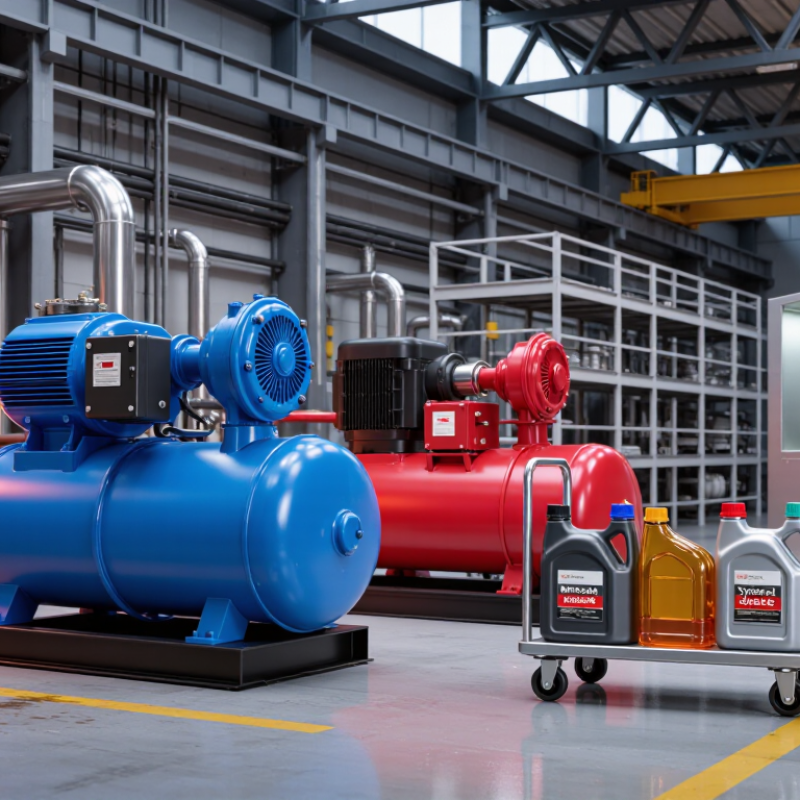
Choosing industrial air compressor oil starts with understanding its type, not its label color. The base stock affects heat resistance, oxidation control, and service life. Mineral oil is often economical for moderate temperatures and uncomplicated duty cycles. Synthetic oil usually performs better under continuous operation, high discharge temperatures, or frequent loading. PAO-based fluids offer strong low-temperature flow and oxidation stability. Ester fluids can provide excellent cleanliness, but compatibility requires careful checking.
The compressor design also matters. Rotary screw compressors commonly need low-foaming oil with reliable air and oil separation. Reciprocating compressors may require different viscosity behavior because piston rings create repeated friction and temperature changes. Food-processing environments may require specially approved lubricants, while dusty workshops need stronger deposit control. Always compare the oil specification, viscosity grade, and material compatibility with the compressor manual. Do not guess.
In field inspections, darkened oil, rising discharge temperature, or a sharp burnt smell often signals trouble. A clean sight glass does not prove the oil is healthy. Sampling can reveal oxidation, metal wear, moisture, or contamination before failure occurs. Small detail, big consequence. Mixing mineral and synthetic fluids may reduce performance or damage seals, depending on their chemistry. Drain lines, filters, and separators also influence oil life, so changing the fluid alone may not solve recurring problems. I have seen maintenance schedules followed perfectly while poor ventilation quietly shortened oil life. The correct type is only one part of dependable lubrication.
| Industrial Compressor Oil Type | Base Chemistry | Common Compressor Applications | Typical ISO VG Grades | Typical Service Temperature | Typical Oil-Change Planning Range | Main Advantages | Important Limitations |
|---|---|---|---|---|---|---|---|
| Mineral R&O Compressor Oil | Refined mineral base oil with rust-and-oxidation-inhibited additives | Reciprocating compressors and lightly to moderately loaded rotary compressors operating in normal ambient conditions | ISO VG 32, 46, 68, 100 | Generally suitable for normal compressor discharge temperatures; confirm the lubricant temperature limit in the equipment manual | Approximately 2,000–4,000 operating hours, subject to contamination, temperature, and oil analysis | Low initial cost; widely available; suitable for many conventional air compressor designs | Shorter oxidation life and higher deposit risk than many synthetic lubricants, especially at high temperature |
| Hydrotreated Synthetic Compressor Oil | Highly refined hydrocarbon base oil with controlled molecular composition | Rotary screw, vane, and reciprocating compressors requiring improved oxidation stability | ISO VG 32, 46, 68 | Broad operating range compared with conventional mineral oil; actual limits depend on formulation and compressor design | Approximately 4,000–8,000 operating hours when supported by the compressor manual and oil analysis | Improved oxidation resistance, cleaner operation, better low-temperature flow, and potentially longer drain intervals | Higher purchase cost; performance varies significantly among formulations |
| PAO-Based Synthetic Oil | Polyalphaolefin synthetic hydrocarbon base oil with performance additives | High-duty rotary screw compressors, mobile compressors, and equipment exposed to cold starts or temperature variation | ISO VG 32, 46, 68 | Good low-temperature fluidity and high-temperature stability; verify the product's viscosity-temperature limits | Approximately 4,000–8,000 operating hours, depending on load, temperature, and contamination control | Good oxidation stability, low volatility, strong wear protection, and reliable performance during temperature changes | More expensive than mineral oil; some seal materials and flushing procedures require compatibility checks |
| Ester-Based Synthetic Oil | Synthetic ester base oil, commonly selected for high-temperature or environmentally sensitive applications | Specialized rotary and reciprocating compressors where high lubricity, deposit control, or biodegradability is required | ISO VG 32, 46, 68 | Often suitable for elevated temperatures, but hydrolytic stability and moisture exposure must be evaluated | Approximately 3,000–6,000 operating hours, depending on formulation and moisture control | High lubricity, good thermal performance, and low volatility; some formulations offer improved environmental characteristics | Can react adversely with water; may affect certain elastomers, paints, or residual mineral oils if compatibility is not confirmed |
| PAG-Based Synthetic Oil | Polyalkylene glycol synthetic base oil | Selected reciprocating or rotary compressor systems specifically approved for PAG lubricants | ISO VG 32, 46, 68 | Good viscosity stability in appropriate applications; operating limits are formulation-specific | Approximately 2,000–4,000 operating hours unless the equipment and lubricant supplier specify otherwise | High lubricity, good deposit control in suitable systems, and useful performance in selected high-temperature applications | Often incompatible with mineral oils, PAO oils, some seals, and some coatings; do not substitute without written approval |
| Food-Grade Compressor Lubricant | Mineral or synthetic base oil formulated to meet applicable incidental-food-contact requirements | Compressed-air systems used in food, beverage, pharmaceutical, and packaging production areas | ISO VG 32, 46, 68 | Depends on the certified formulation and compressor operating temperature | Follow the lubricant approval, compressor manual, and site contamination-control program; do not assume extended drains | Supports hygiene requirements when correctly certified and managed; available in mineral and synthetic formulations | Certification does not make the oil suitable for every compressor; it may cost more and still requires filtration and maintenance controls |
| Vacuum Pump or Oil-Flooded Compressor Fluid | Specialized mineral or synthetic fluid engineered for vacuum, sealing, cooling, or oil-flooded compression | Vacuum pumps and compressor designs requiring a dedicated fluid rather than a general-purpose compressor oil | Commonly ISO VG 32, 46, 68, or a manufacturer-specific viscosity | Must be selected according to inlet pressure, discharge temperature, gas composition, and equipment design | Application-specific; monitor viscosity, acidity, particulate contamination, and volatile loss | Designed for the particular sealing, cooling, and gas-handling requirements of the equipment | A general compressor oil may cause poor sealing, excessive foaming, deposits, or premature wear if the design requires a dedicated fluid |
| Selection note: Choose the oil viscosity and chemistry specified by the compressor manufacturer. ISO VG numbers describe the lubricant's kinematic viscosity at 40°C; they do not by themselves confirm suitability. Before changing oil type, check compressor design, discharge temperature, ambient conditions, gas composition, seal compatibility, food-contact requirements, and whether the new oil is miscible with the existing lubricant. The service-hour ranges shown are general planning values, not universal replacement intervals. | |||||||
Match the oil to the compressor design, temperature, load pattern, and operating environment. Do not guess. Check the manual, viscosity grade, performance class, and material compatibility.
Mineral oil can suit moderate temperatures and uncomplicated duty cycles. It may offer a lower purchase cost. However, continuous high-load operation can shorten its useful life.
Synthetic oil usually suits continuous operation, high discharge temperatures, and frequent loading. It often provides stronger oxidation resistance. Actual results still depend on ventilation, contamination, and seal materials.
Rotary screw compressors commonly need low-foaming oil with reliable air and oil separation. The fluid must seal internal clearances and carry heat away. Foam is a warning sign.
Yes. Reciprocating compressors experience pressure pulses and repeated piston-ring friction. The oil must protect rings, valves, and bearings under changing temperatures. Viscosity behavior matters.
Measure discharge temperature, ambient temperature, load pattern, and moisture exposure. A compressor beside a dusty furnace needs extra deposit control. A humid room may encourage corrosion and emulsification.
Darkened oil, rising discharge temperature, metallic dust, foam, or a burnt smell deserve investigation. A clean sight glass proves very little. Laboratory testing can detect water, oxidation, viscosity changes, and wear metals.
Mixing mineral and synthetic fluids may reduce performance or damage seals. Compatibility depends on their chemistry and the compressor materials. Drain the old fluid fully when possible. I would still verify compatibility before mixing anything.
Choosing the right Industrial Air Compressor Oil Type is essential for reliable performance, efficient heat control, and longer equipment life. The best choice depends on the compressor’s design, such as rotary screw, reciprocating, or centrifugal systems, as well as operating temperature, pressure, duty cycle, humidity, and contamination exposure. Mineral, synthetic, and semi-synthetic oils each offer different levels of oxidation resistance, low-temperature flow, service life, and cost efficiency, so selection should reflect the actual working environment rather than price alone.
Before filling the system, verify the recommended viscosity grade, additive package, performance standards, and manufacturer requirements. Avoid mixing oils unless compatibility has been confirmed, since unsuitable combinations may reduce lubrication quality or create deposits. A practical maintenance plan should define oil-change intervals based on operating hours and condition monitoring. Regularly checking oil color, odor, viscosity, temperature, pressure, and filter condition can reveal early signs of wear or contamination, helping maintain safe, stable, and efficient compressor operation.
