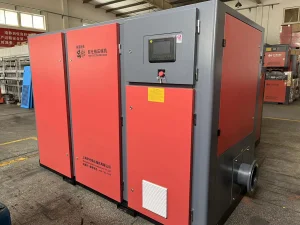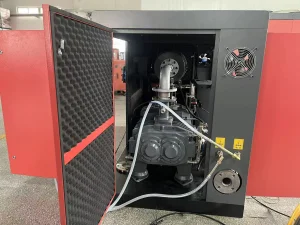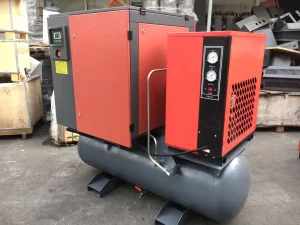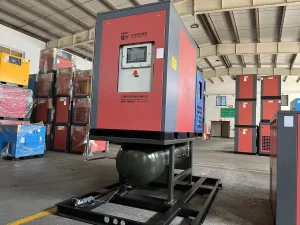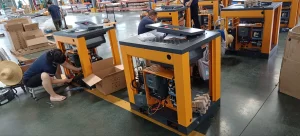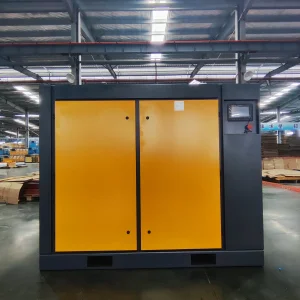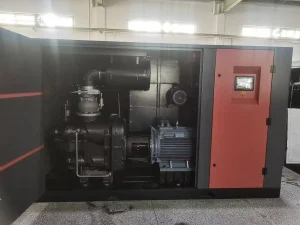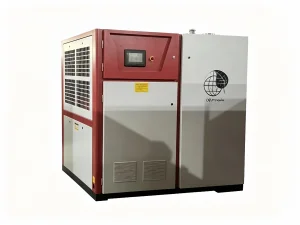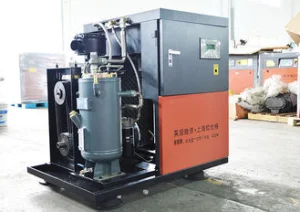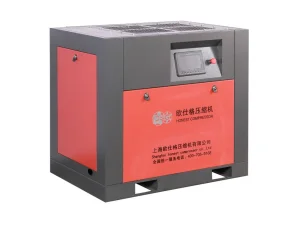
Highly engineered low-pressure screw architectures featuring permanent magnet motors and smart VSD controls.
Ethiopia’s industrial strategy has shifted from agrarian reliance to high-value manufacturing. Under the Growth and Transformation Plan (GTP), specialized industrial parks have emerged as hubs for textile processing, food manufacturing, pharmaceuticals, and leather production.
Many of these processes rely on process air. In the food and pharmaceutical sectors, air purity is critical. Traditional oil-flooded compressor and blower systems pose a constant risk of hydrocarbon contamination, which can compromise product quality and damage manufacturing equipment. The demand for ISO 8573-1 Class 0 certified oil-free screw blowers is growing among quality-conscious plants in the region.
With wastewater discharge regulations strictly enforced (including Zero Liquid Discharge - ZLD plants), efficient aeration blowers are vital. Operating 24/7, these biological oxidation processes consume up to 65% of the wastewater facility's total energy budget. Upgrading from old Roots-type positive displacement blowers to screw-based aeration units offers significant energy savings.
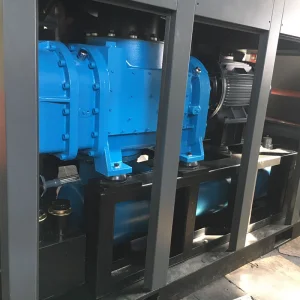
Unlike traditional lobe-type Roots blowers that operate via external compression, a dry screw blower relies on a male and female helical rotor profile that compresses the air internally as it flows through the screw element. This internal compression is the primary reason why screw blowers achieve high thermodynamic efficiency.
| Performance Parameter | Dry Screw Blower Tech (OEM VSD) | Traditional Roots Blower | Industrial Advantage |
|---|---|---|---|
| Internal Compression | Yes (Dynamic Profile Design) | No (External Compression) | Reduces energy losses by up to 30% |
| ISO 8573-1 Class 0 Certification | Guaranteed 100% Oil-Free | Prone to seal degradation/migration | Zero risk of process contamination |
| Aerodynamic Efficiency | Up to 82% polytropic efficiency | 45% - 60% efficiency range | Substantially lower utility bills |
| Acoustic Emission | 63 - 72 dB(A) with sound enclosure | 85 - 100 dB(A) (Requires high shielding) | Improved workplace safety and comfort |
| Operational VSD Range | 30% to 100% dynamic scaling | Poor speed range control | Adapts closely to variable load demands |
The continuous internal compression reduces turbulence and backflow, which maintains a stable air delivery temperature and prevents energy loss from excessive heat generation.
Exporting industrial machinery to Ethiopia requires careful engineering attention to altitude and barometric pressure. Addis Ababa sits at an average elevation of 2,355 meters (7,725 feet) above sea level.
At this elevation, atmospheric pressure drops to approximately 76 kPa (compared to 101.3 kPa at sea level), and air density falls to roughly 0.96 kg/m³.
In biological wastewater treatment (such as activated sludge processes), microorganisms require a specific mass flow rate of oxygen to metabolize organic matter. Since the oxygen concentration by volume remains relatively constant, the decrease in air density means that a larger volumetric flow (FAD - Free Air Delivery) must be compressed to deliver the same mass of oxygen.
The Ethiopian electric grid can experience voltage sags and frequency fluctuations. Standard induction motors struggle under these conditions, leading to winding degradation.
We configure our blowers with Permanent Magnet Motors driven by Liquid-Cooled/Air-Cooled VSD Inverters. These drives are rated to operate within a $\pm15\%$ voltage variance range, protecting the motor stator coils while maintaining consistent pressure control down to 30% of nominal speed.
Procuring engineering systems from overseas requires strict compliance with international testing and shipping practices. When ordering equipment for Ethiopian installation, specify the following parameters:
Engineered systems built to international ISO standards for clean process air and gas compression applications.
Purchasing process machinery requires structured post-sales technical support. Our distribution network provides targeted services for the Ethiopian market:
We organize container shipments with robust packing (moisture barrier wrapping and heavy-duty sea transport crates) designed to handle multi-modal rail and road transit along the Djibouti-Addis corridor.
To minimize plant downtime, our logistics system ensures the availability of maintenance consumables, including dry screw air-end maintenance kits, specialized synthetic high-temperature lubricants for the timing gears, air filter cartridges, and high-durability labyrinth seals.
Our oil-free screw blowers meet the environmental discharge standards mandated by the federal Ministry of Environment, Forest and Climate Change (EFCCC) of Ethiopia. This guarantees that your biological wastewater reactors run free from chemical contaminants.
In biological oxidation (wastewater aeration) and direct product contact processes, even trace oil aerosols can damage micro-organisms, clog fine-bubble diffuser plates, and contaminate fabrics or food products. A Class 0 oil-free screw blower operates dry, isolating the lubrication oil within the gear and bearing housing using physical carbon ring seals and venting channels, eliminating the risk of hydrocarbon migration into the air stream.
Our engineering team uses correction factors for ambient pressure ($76 \text{ kPa}$) and density ($0.96 \text{ kg/m}^3$). This involves sizing a larger displacement screw rotor to achieve the target mass flow of oxygen, and pairing it with a larger frame size motor to prevent thermal overloading under high-elevation cooling conditions.
Because the screw rotors do not contact each other (synchronized by high-precision timing gears), wear within the compression housing is minimal. Routine maintenance is limited to changing air inlet filters every 2,000 to 4,000 hours and replacing the timing gear lubricant every 8,000 hours, which significantly lowers operating costs compared to typical sliding-vane or liquid-ring systems.
Yes. The integrated permanent magnet motor control is matched with VSD inverters designed for fluctuating voltage inputs. The system features automatic low-voltage ride-through and phase-loss protections to ensure safe operation during power grid instability.
Need custom pressure configurations, high-altitude motor adaptations, or specific layout drawings? Contact our technical engineering division today.
Send Inquiry Now